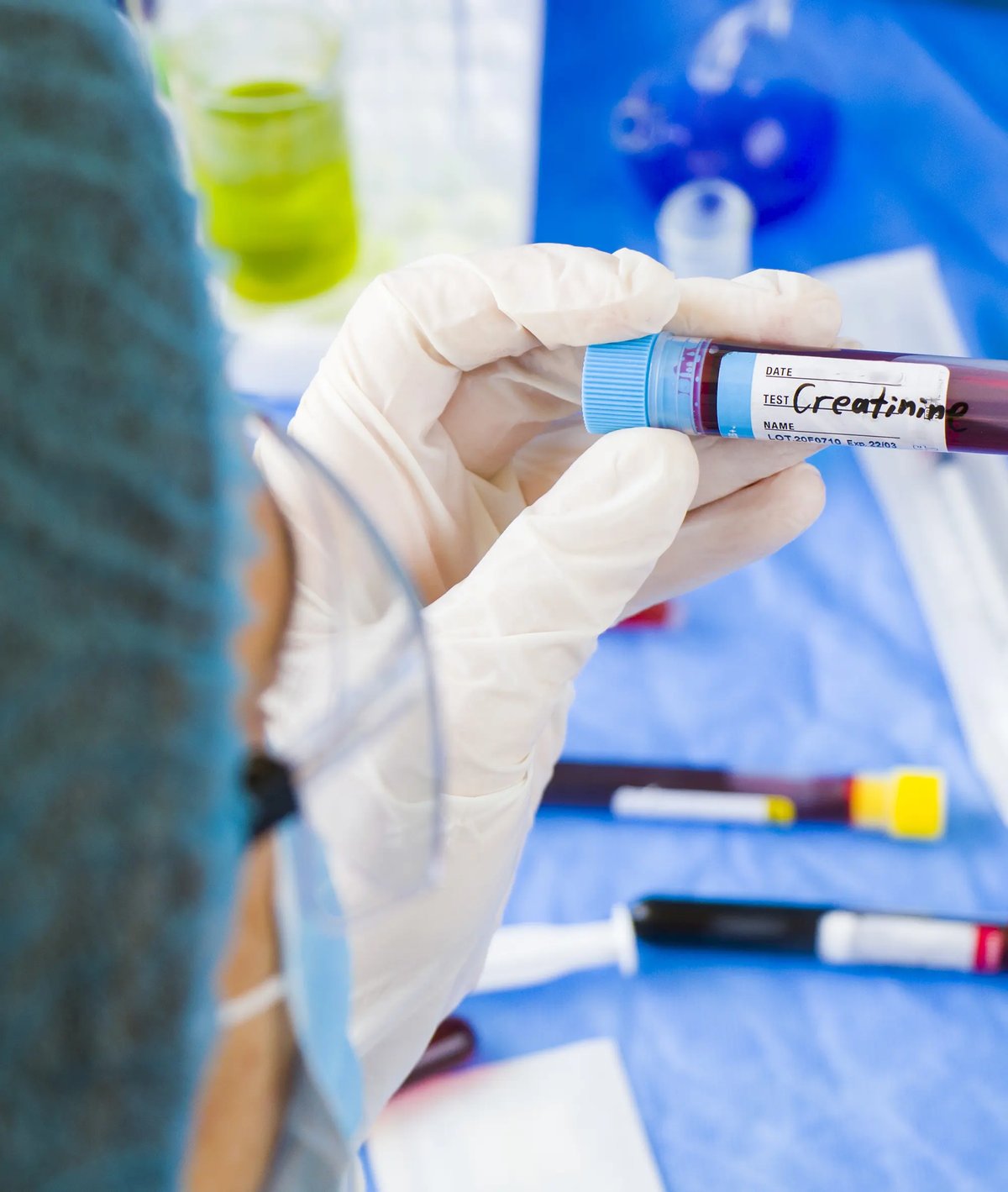
If your blood test came back with creatinine above the reference range, the first useful thing I can tell you is that a single high value does not establish that your kidneys are damaged. It is one of the most frequent reasons people come to my office worried, and in a meaningful share of cases the explanation turns out to be something temporary.
That said, it is also one of the markers I take most seriously when it stays high. So the goal here is to help you tell those two situations apart, and to be honest about what actually brings the number down.
This article is educational and does not replace an evaluation by your own physician.
What creatinine is
Creatinine is a waste product from the normal metabolism of creatine, a substance in muscle involved in producing energy. Your muscles generate it continuously, at a fairly steady rate, and the kidneys filter it out into the urine.
That steadiness is what makes it useful. If the kidneys filter well, creatinine stays stable. If filtering capacity drops, creatinine accumulates and the blood level rises. It works as an indirect window onto kidney function.
It is an imperfect window, and it is worth knowing why.
Normal ranges, and why they are not universal
Typical laboratory ranges:
- Men: 0.7 to 1.3 mg/dL
- Women: 0.6 to 1.1 mg/dL
Because creatinine comes from muscle, muscle mass changes the baseline. A muscular young man can sit slightly above the range with entirely healthy kidneys. An elderly or frail person with little muscle can have meaningfully reduced kidney function while creatinine still reads normal.
This is why we rely on eGFR, the estimated glomerular filtration rate, which adjusts creatinine for age and sex to estimate filtering capacity. It is the more informative number, and it is usually reported right beside creatinine.
Why creatinine rises
Temporary causes, which resolve on their own:
- Dehydration, the single most common explanation for a mildly high result
- Intense exercise in the preceding 24 to 48 hours
- A very high protein diet, particularly large amounts of red meat
- Creatine supplements, common among people who train
- Acute illness with fever
Causes that need attention:
- Chronic kidney disease from diabetes or high blood pressure, the two leading causes
- Acute kidney injury from severe dehydration, infection, contrast dye or medication
- Medications, particularly regular nonsteroidal anti inflammatories, certain antibiotics, some blood pressure drugs and contrast agents
- Urinary obstruction from stones or prostate enlargement
- Glomerular disease
- Heart failure, which reduces blood flow to the kidneys
Temporary versus persistent
This distinction determines everything that follows.
A temporary rise is usually mild, has an obvious explanation, and returns to baseline when the test is repeated under normal conditions. If you were dehydrated, had a fever, or trained hard the day before, repeat the test properly hydrated and rested.
A persistent rise stays high across repeated tests weeks apart, often comes with a falling eGFR, and frequently appears alongside protein in the urine. That combination is what points to kidney disease rather than a one off.
The trend matters more than any single value. A stable creatinine of 1.4 for five years is a different situation from one that moved from 0.9 to 1.4 in eight months.
Symptoms
Mildly elevated creatinine usually causes nothing at all. Symptoms appear only when kidney function has dropped substantially:
- Fatigue that rest does not resolve
- Swelling in the legs, ankles or around the eyes
- Changes in urination, especially at night
- Foamy urine
- Nausea and loss of appetite
- Difficulty concentrating
- Itching without a rash
- Muscle cramps
The absence of symptoms is not reassurance. It is the normal state of early kidney disease.
The workup
Repeat creatinine with eGFR, under proper conditions.
Urine albumin-to-creatinine ratio, to see whether the filters are leaking. Creatinine plus protein together is far more informative than creatinine alone.
Urinalysis, looking for blood, protein or cells.
Basic blood work: electrolytes, glucose, HbA1c, blood count.
Kidney ultrasound, to assess size and structure and rule out obstruction.
Additional testing for specific conditions when the picture warrants it.
How to lower creatinine
This is the section most people came for, so I want to be both practical and honest.
Creatinine falls when the reason it rose is corrected. There is no food, drink or supplement that lowers it directly, and any source telling you otherwise is selling something. What follows genuinely works, in rough order of impact.
Correct dehydration, and stay adequately hydrated. If low fluid intake caused the rise, restoring normal hydration resolves it. Steady intake through the day, enough that urine stays light in color. More is not better: forcing large volumes does not improve kidney function and can cause its own problems, particularly if function is already reduced.
Review every medication and supplement with your physician. This is where I most often find something actionable. Regular nonsteroidal anti inflammatories are the usual culprit, and many people do not consider them medication at all. Certain antibiotics, some blood pressure combinations and proton pump inhibitors can also contribute. Do not stop a prescribed medication on your own, but do bring the complete list, including anything over the counter.
Stop creatine supplements. They raise creatinine directly, without any kidney problem, and they are a frequent cause of a scary looking result in people who train.
Control blood pressure. For most people with kidney disease this is the highest impact long term action. Well controlled pressure slows the loss of filtering capacity more reliably than anything else available.
Control blood sugar if you have diabetes. Sustained control protects the filters and reduces protein loss.
Treat proteinuria, typically with an ACE inhibitor or an ARB. A short term detail worth knowing: these medications can cause a small rise in creatinine when started, and that expected rise reflects a change in filtration pressure, not damage. Your physician will monitor it. Stopping the medication because of it is usually the wrong move.
Moderate protein intake, without eliminating it. Very high protein diets increase the filtering workload. This should be individualized rather than self prescribed, because inadequate protein causes muscle loss and its own harms. If you have reduced kidney function, ask for a specific target rather than guessing.
Reduce dietary sodium. It makes blood pressure control achievable, which is the real mechanism of benefit.
Relieve any obstruction. If a stone or an enlarged prostate is blocking flow, creatinine will not improve until that is addressed, and treating it often produces a rapid fall.
Do not smoke. Smoking accelerates kidney damage and undermines the benefit of everything above.
Be cautious with contrast studies if your function is already reduced. They are sometimes necessary, and when they are, hydration protocols reduce the risk. Make sure whoever orders the scan knows your kidney function.
What does not work: herbal cleanses, detox teas, high dose vitamin regimens and restrictive protocols promoted for kidney cleansing. Some are merely useless. Others contain compounds that are actively harmful to the kidney, and I have seen people arrive worse after trying them.
When to see a nephrologist
- Creatinine stays high across repeated tests
- eGFR is below 60, or falling over time
- Protein or blood appears in the urine
- You have diabetes or high blood pressure with rising creatinine
- Creatinine rose sharply over days or weeks
- You have had recurrent kidney stones or urinary obstruction
- A family history of kidney disease
Talk to a nephrologist in Santo Domingo
I am Dr. Elizabeth Villanueva, a nephrologist and internist practicing in Santo Domingo, Dominican Republic. A great deal of my work consists of taking a result that frightened someone and turning it into an explanation and a plan, which frequently means identifying something reversible that nobody had looked for.
Bring your lab reports, including earlier ones so the trend is visible, along with your full medication and supplement list.
Request an appointment or read more about how I work.